

使用Fashion MNIST数据集:https://www.kaggle.com/datasets/zalando-research/fashionmnist。
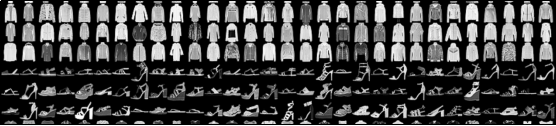
数据集中每个样本都是28×28的灰度图像,与来自10个类别的标签相关联。标签对应如下:
- 0:T恤/上衣
- 1:裤子
- 2:套头衫
- 3:连衣裙
- 4:外套
- 5:凉鞋
- 6:衬衫
- 7:运动鞋
- 8:包
- 9:靴子
8.5.1 加载数据

import torch
import pandas as pd
import torch.nn as nn
import matplotlib.pyplot as plt
from torch.utils.data import TensorDataset, DataLoader

# 读取数据
fashion_mnist_train = pd.read_csv("data/fashion-mnist_train.csv")
fashion_mnist_test = pd.read_csv("data/fashion-mnist_test.csv")
# 将数据转换为张量,原数据形状为n×1×784,转换为n×1×28×28的张量
X_train = torch.tensor(fashion_mnist_train.iloc[:, 1:].values, dtype=torch.float32).reshape(-1, 1, 28, 28)
y_train = torch.tensor(fashion_mnist_train.iloc[:, 0].values, dtype=torch.int64)
X_test = torch.tensor(fashion_mnist_test.iloc[:, 1:].values, dtype=torch.float32).reshape(-1, 1, 28, 28)
y_test = torch.tensor(fashion_mnist_test.iloc[:, 0].values, dtype=torch.int64)
plt.imshow(X_train[12345, 0, :, :], cmap="gray")
plt.show()
# 构建数据集
train_dataset = TensorDataset(X_train, y_train)
test_dataset = TensorDataset(X_test, y_test)
8.5.2 搭建模型
搭建如下结构的模型:
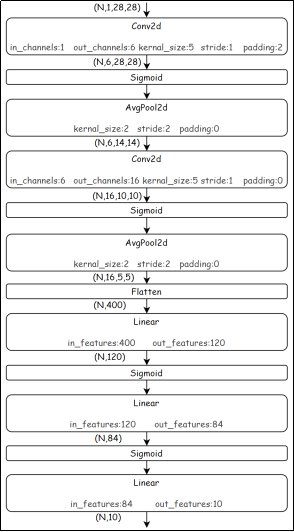
# 搭建模型
model = nn.Sequential(
    nn.Conv2d(1, 6, kernel_size=5, padding=2),
    nn.Sigmoid(),
    nn.AvgPool2d(kernel_size=2, stride=2),
    nn.Conv2d(6, 16, kernel_size=5),
    nn.Sigmoid(),
    nn.AvgPool2d(kernel_size=2, stride=2),
    nn.Flatten(),  # 拉平
    nn.Linear(400, 120),
    nn.Sigmoid(),
    nn.Linear(120, 84),
    nn.Sigmoid(),
    nn.Linear(84, 10),
)
给模型一个输入,测试各层输出值形状是否符合预期:
# 查看各层输出数据的形状
X = torch.rand(size=(1, 1, 28, 28), dtype=torch.float32)
for layer in model:
    X = layer(X)
    print(f"{layer.__class__.__name__:<12}output shape: {X.shape}")
8.5.3 模型训练
先初始化线性层和卷积层的权重参数。使用交叉熵损失函数和SGD优化方法。每个epoch中在训练集上训练模型,并在验证集上验证模型的准确率。
# 模型训练
def train(model, train_dataset, test_dataset, lr, epoch_num, batch_size, device):
    def init_weights(layer):
        # 对线性层和卷积层使用Xavier均匀分布初始化参数
        if type(layer) == nn.Linear or type(layer) == nn.Conv2d:
            nn.init.xavier_uniform_(layer.weight)

    model.apply(init_weights)  # 初始化参数
    model.to(device)  # 将模型加载到设备
    loss = nn.CrossEntropyLoss()  # 损失函数
    optimizer = torch.optim.SGD(model.parameters(), lr=lr)  # 优化器
    for epoch in range(epoch_num):

        # 训练过程
        model.train()  # 将模型设置为训练模式
        train_loader = DataLoader(dataset=train_dataset, batch_size=batch_size, shuffle=True)
        loss_accumulate = 0
        train_correct_accumulate = 0
        for batch_count, (X, y) in enumerate(train_loader):
            # 前向传播
            X, y = X.to(device), y.to(device)
            output = model(X)
            # 反向传播
            loss_value = loss(output, y)
            optimizer.zero_grad()
            loss_value.backward()
            optimizer.step()
            # 累加损失
            loss_accumulate += loss_value.item()
            # 累加正确输出的数量
            _, pred = output.max(1)
            train_correct_accumulate += pred.eq(y).sum()
            # 打印进度条
            print(f"\repoch:{epoch:0>2}[{'='*(int((batch_count+1) / len(train_loader) * 50)):<50}]", end="")
        this_loss = loss_accumulate / len(train_loader)  # 计算平均损失
        this_train_correct = train_correct_accumulate / len(train_dataset)  # 计算训练准确率

        # 验证过程
        model.eval()  # 将模型设置为评估模式
        test_loader = DataLoader(dataset=test_dataset, batch_size=batch_size, shuffle=True)
        test_correct_accumulate = 0
        with torch.no_grad():  # 关闭梯度计算
            for X, y in test_loader:
                # 前向传播
                X, y = X.to(device), y.to(device)
                output = model(X)
                # 累加正确输出的数量
                _, pred = output.max(1)
                test_correct_accumulate += pred.eq(y).sum()
        this_test_correct = test_correct_accumulate / len(test_dataset)  # 计算验证准确率

        # 打印损失,训练准确率,验证准确率
        print(f" loss:{this_loss:.6f}, train_acc:{this_train_correct:.6f}, test_acc:{this_test_correct:.6f}")

device = torch.device("cuda" if torch.cuda.is_available() else "cpu")  # 如果cude可用则使用cuda,否则使用cpu
train(model, train_dataset, test_dataset, lr=0.9, epoch_num=20, batch_size=256, device=device)
© 版权声明
文章版权归作者所有,未经允许请勿转载。
THE END











请登录后查看评论内容